
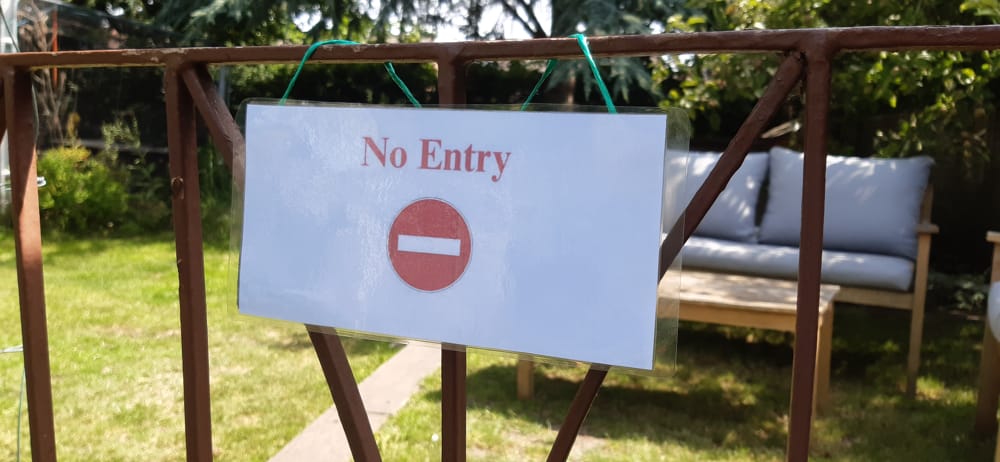
Because fear is not seen as a desirable trait professionally, it can often be subtle and well disguised across an organisation’s practices and procedures. And yet it is a perfectly normal human emotion. In care practices this can manifest in different ways in relation to engaging with the garden:
- putting off decisions about installing new garden items (reluctance and delay),
- making excuses (blaming: the weather, the garden, staffing),
- closing down conversations that challenge the reasons for not doing something (avoidance, distracting to avoid looking to closely)
- timidity in trying something new or supporting change, reluctance to even try modest experiments (resistance / creating obstacles).
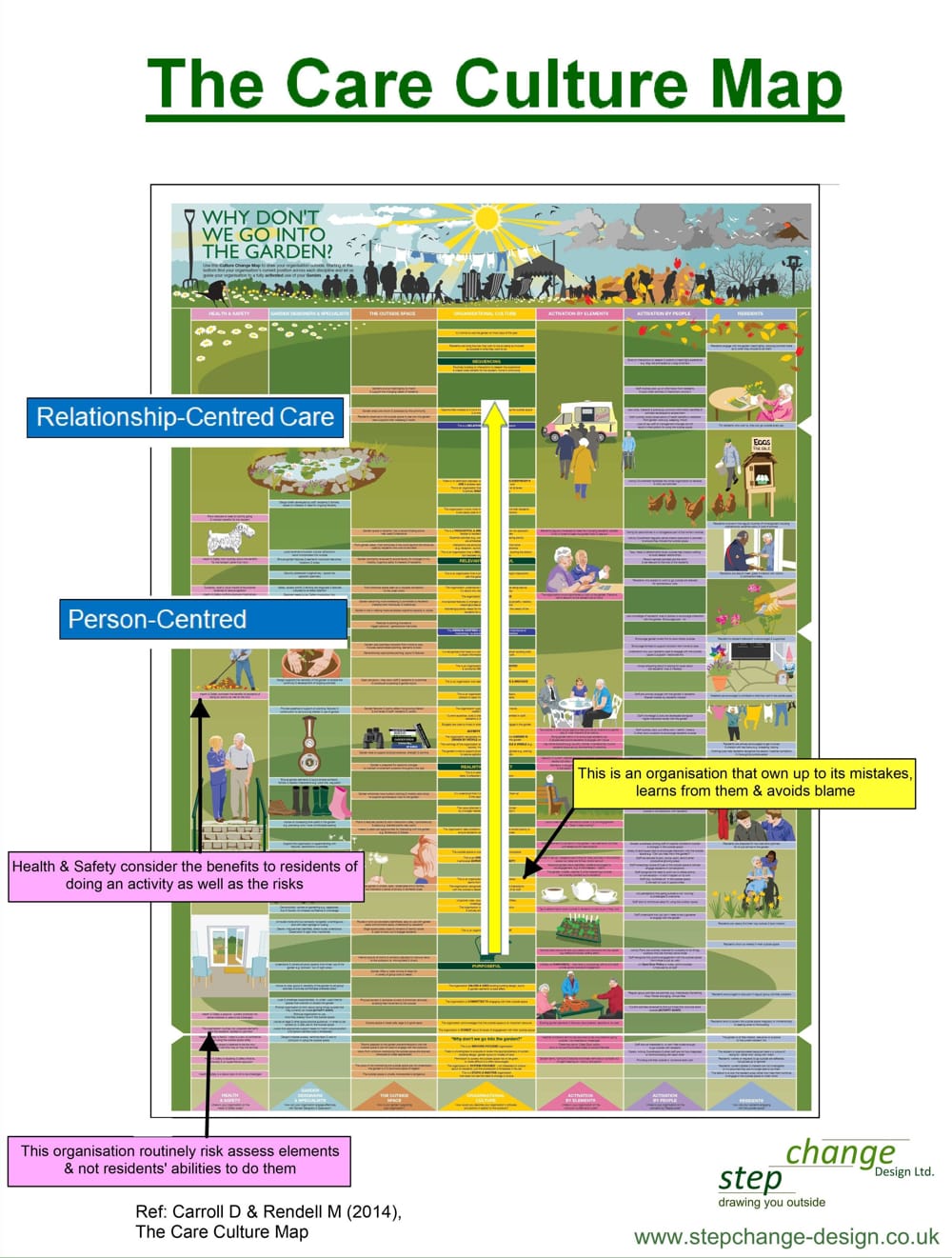 In one care home in our research we encountered a situation that we termed a ‘legacy of fear’. A traumatic accident that happened to a resident in a particular area of the garden had created a reluctance to go there, and subsequent cordoning off that part of the garden. Consequently, a new habit or ‘rule’ was allowed to take hold which meant that part of the garden was not used.
Over time, this rule became the norm so when we visited and asked why this area of the garden was not being used we were told about Fred’s accident there. When we enquired how he was doing we were shocked to be told that this took place five years ago and sadly Fred had passed away since then.
So for five years, every garden visitor was prevented from engaging with this area because of the fears that had taken hold. Instead of tackling the root cause of Fred’s fall, which were later revealed to be unrelated to the garden, and to promptly correct any problem there a residual and misplaced fear had been allowed to build. Even members of staff who had never met Fred perpetuated the myth and blamed the garden.
This historic incident was allowed to continue to negatively impact the behaviour, attitudes and activities in this care home in relation to using their garden areas because of this Legacy of Fear.
A more responsive approach would be to seek to learn as much as possible from the incident and to focus subsequent actions away from blaming the garden towards encouraging and supporting staff and garden visitors to look objectively at how to fix any garden features, if they were the cause, or how to support the resident where there may be concerns with their health or current capabilities. This is a more person-centred approach enabling visits to continue by tailoring the supervision or support according to individual needs and thus ensuring the garden remains accessible.
This example shed light on the various ways that care settings respond to incidents outdoors, their interpretation of risk and how they may apply health and safety guidance. In care settings where there are fearful approaches, we often find the garden is blamed. It is an easy target as it doesn’t argue back, yet frequently we find it is rarely the main cause, or where taking action to resolve this is slow, which is regrettably far too often, the area is simply closed off depriving the residents of any future engagement with that space.
Responding effectively to incidents requires a setting to create a culture where they are actively encouraged to learn from their mistakes, when they occur. Resorting to blame, whether that be of people, practice or in this case the garden, is replaced by focusing on taking the steps to prevent a recurrence through improved practices, deeper understanding of individual residents and taking corrective actions to the environment while balancing this with enabling continued engagement outside. We believe this is a major step forward in achieving person-centred care practices.
Designers, and other specialists, can have an important role to play here, bringing their fresh eyes and insights to reveal these unhelpful and hidden fears that have become subconscious practices at the care setting. They need to be observant and notice anomalies and not to take everything at face value during initial interviews and site visits. By asking the right questions they can prompt reflection and greater self-awareness on the part of the setting about their current practices that have become ‘normal’ yet may need revisiting. Helping to unpick any ‘Legacies of Fear’ and supporting appropriate changes in their care practices and procedures in the garden environment itself is essential if continued enjoyment outside by as many residents as possible is to be maintained.
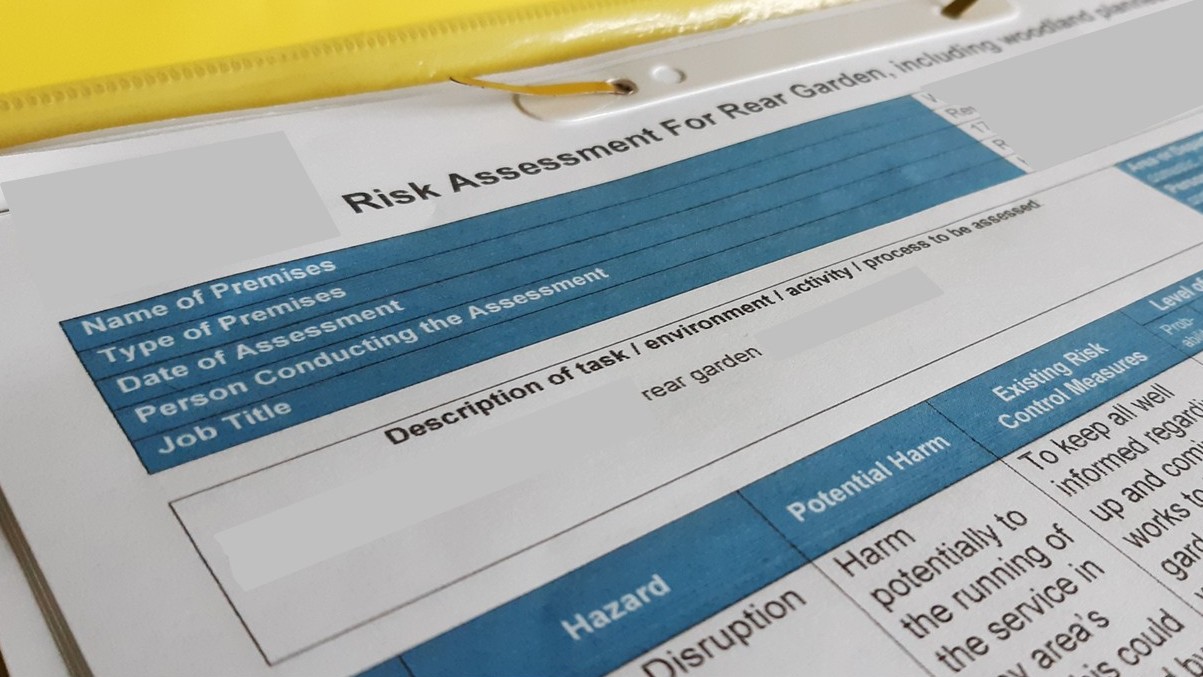 Different sectors have different ‘norms’ around Health and Safety risk assessment practices and these will subtly influence how scenarios such as the one we have described here will be challenged or perhaps reinforced. Importantly, designers and other outside specialists need to remain open to revisiting their own preconceived norms and beliefs around risk assessment to ensure they do not become part of perpetuating a past legacy of fear, or build in new fears, so inadvertently holding the care setting back from progressing to more advanced care practices.
We investigate risk assessments within a person-centred care setting in our next blog and more can be found around these topics in our Care Culture Map and Handbook, and for Designers in our Designer focused handbook.
Step Change Design focuses on encouraging care settings to take a fresh look at their care culture practices helping to embed Person-Centred care in order to enable residents to engage actively and meaningfully with their outside spaces. Our work is based on our large scale research project to understand why care setting gardens are not more actively used. They also support Garden Designers in working effectively with Care clients in an approach to delivering design support they call ‘Relationship-Centred Design’.
Our ‘Why don’t we go into the garden?’ series of Books and Tools provide a range of support to both the Care and Design sectors with the aim of improving residents lives, enabling them to step outside as they wish.
This Blog is based on an original series of articles written for Bright Copper Kettle an organisation providing resources and training for Activity Co-Ordinators in Care Homes