
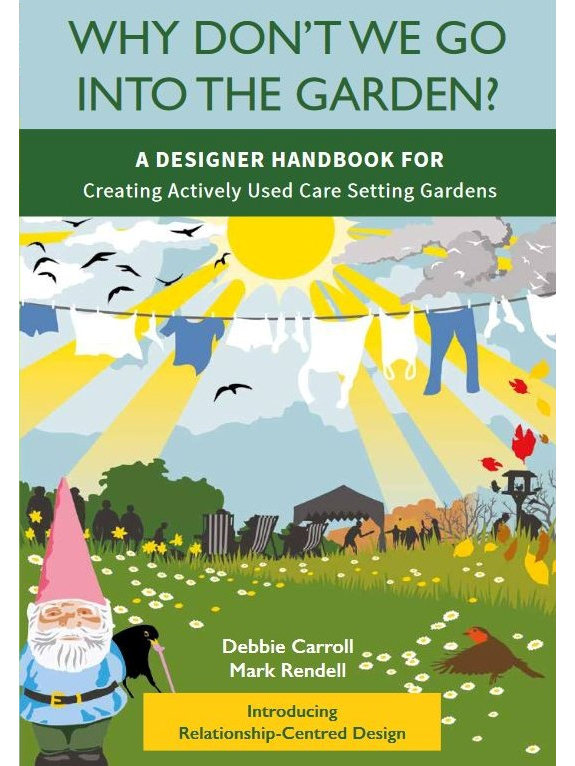

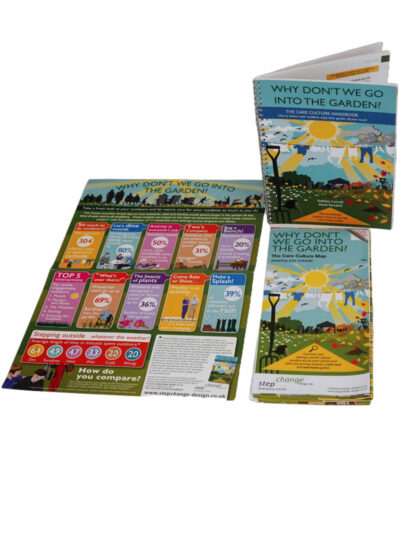
Why don’t we go into the garden? – A Designer Handbook for Creating Actively Used Care Setting Gardens
£18.00
An award winning Designer Handbook for Creating Actively Used Care Setting Gardens
ISBN No. 9780993573712
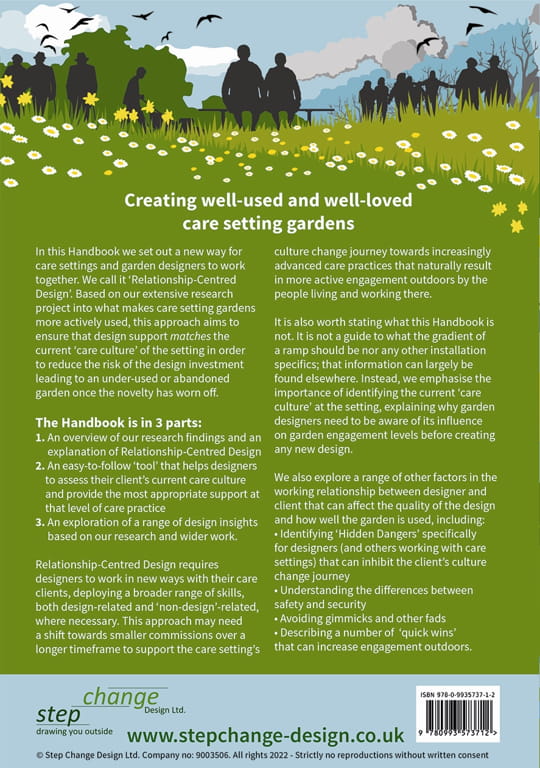
This award winning care home garden design handbook supports garden designers, and those who support care settings, to create well-used and well-loved care home garden designs. Based on our extensive research project into what makes care home gardens more actively used. In it we share a new way of working with care settings called ‘Relationship-Centred Design’. This approach ensures that design support matches the current care culture of the setting to reduce the risk of the design investment leading to an under-used or abandoned garden once the novelty of a new space has worn off.
Real-life stories illuminate this thought provoking book and brings to life how to ensure gardens are meaningfully developed and used, and with particular reference to people living with dementia.
It is also worth stating what this Handbook is not; it is not a guide to what the gradient of a ramp should be nor other installation specifics; many other books cover these topics effectively.
It does however provide a detailed ‘Care Culture Banding tool’ to assess the care culture at a setting and the suggested support to apply to match this appropriately. This is most helpful at the beginning of any relationship between garden designers and care home clients, ensuring an appropriate initial brief and the implementation of support delivered alongside any changes needed to care practices too.
A range of wider insights are also explored that may need to be considered if even the best intended garden is to avoid inadvertently hindering future engagement by care settings. This includes; a range of hidden dangers, avoiding gimmicks and some quick wins.
This product is widely available including via: The Great British Bookshop, as print on demand, and to order through most retailers including Waterstones despatched through Gardners.
Further information is available for Libraries/ trade wishing to purchase directly, please get in touch
In stock
3 reviews for Why don’t we go into the garden? – A Designer Handbook for Creating Actively Used Care Setting Gardens
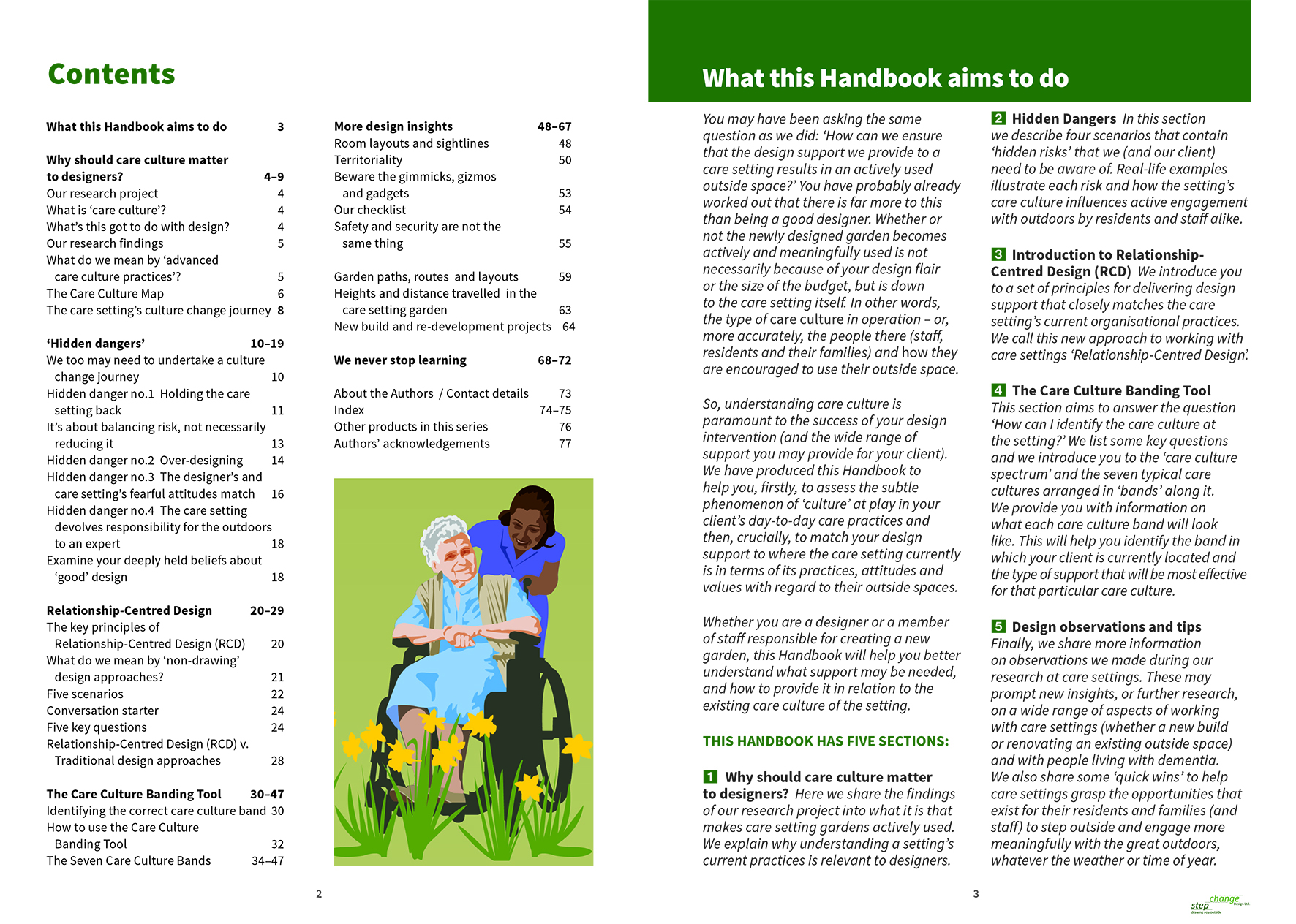
Book Content
What this Handbook aims to do
Why should care culture matter to designers?
Our research project What is 'care culture'?
What's this got to do with design?
Our research findings
What do we mean by 'advanced care culture practices'?
The Care Culture Map
The care setting's culture change journey
'Hidden dangers'
We too may need to undertake a culture change journey
Hidden danger no.1 Holding the care setting back
It's about balancing risk, not necessarily reducing it
Hidden danger no.2 Over-designing
Hidden danger no.3 The designer's and care setting's fearful attitudes match
Hidden danger no.4 The care setting devolves responsibility for the outdoors to an expert
Examine your deeply held beliefs about 'good' design
Relationship-Centred Design
The key principles of Relationship-Centred Design
What do we mean by 'non-drawing' design approaches?
Five scenarios
Conversation starter
Five key questions
Relationship-Centred Design (RCD) v. Traditional design approaches
The Care Culture Banding Tool
Identifying the correct care culture band
How to use the Care Culture Banding Tool
The Seven Care Culture Bands
More design insights
Room layouts and sightlines
Territoriality
Beware the gimmicks, gizmos and gadgets
Our checklist
Safety and security are not the same thing
Garden paths, routes and layouts
Heights and distance travelled in the care setting garden
New build and re-development projects
We never stop learning
About the Authors / Contact details Index
Index
Other products in this series
Authors' acknowledgements
Testimonial:
“This Designer Handbook introducing Relationship-Centred Design evidences ….both the short-comings and solutions. The brilliantly conceived and masterfully presented Banding Tool nails it – especially its Questions to ask, Points to consider and Suggestions for support. And to do this for fully seven bands is insightful and research-rich beyond words. The subtle permeating philosophy being that we all want to grow, learn and improve, whether we are aware at the beginning of the ‘non-drawing design’ process or not.
‘Non-drawing design’ is logically named and conceived - such a powerful, useful concept that encapsulates this new but very old approach. How many dwellings have been constructed around the world for centuries without scratching a plan in the dirt first, but by sitting together to discuss what is needed…?”
Garuth Chalfont, Research, Author & Garden Designer
His book ‘Design for Nature in Dementia Care’ inspired our research project
Additional information
| Weight | 0.35 kg |
|---|---|
| Dimensions | 29.5 × 18.0 × 1.1 cm |
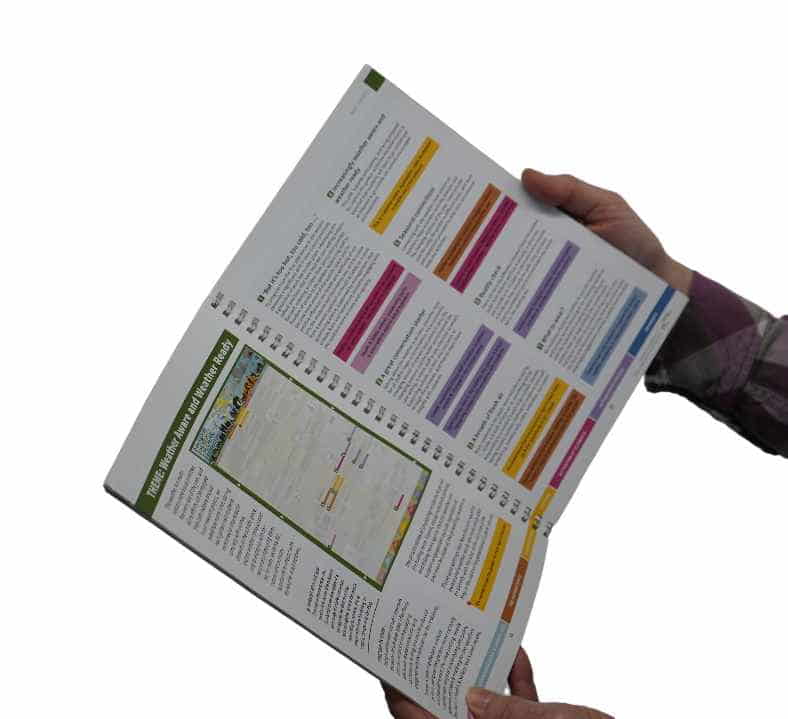
| Handbook | Spiral bound colour handbook, H254mm x W178mm, 76pp |
| BIC | Care of the elderly (JKSG), Garden design & planning (WMD), Health systems & services (MBP), Landscape art & architecture (AMV), Occupational therapy (MQT) |
| BISAC | ARCHITECTURE / Professional Practice (ARC015000), GARDENING / Garden Design (GAR006000), MEDICAL / Allied Health Services / Occupational Therapy (MED003050), MEDICAL / Nursing Home Care (MED059000), SOCIAL SCIENCE / Gerontology (SOC013000) |
| Book Scan class text | Gardening |
| BookScan Class code | T11.2 |
| Dewey | 712.2 |
| Genre | Non-Fiction |
| Thema | 5PMN (Relating to people with degenerative conditions – including dementia, Alzheimer's disease, etc.), AMV (Landscape architecture and design), JKSG (Care of the elderly), MBPN (Residential care – includes elder care, care homes), MQT (Occupational therapy – includes Recreational therapy, Horticultural therapy), WMD (Garden design & planning) |
Bob Scarfo –
Carroll and Rendell’s second summary of their research findings regarding the design and installation of an actively enjoyed garden for people living with dementia provides what most landscape and garden designers wish for but rarely have time to carry out. Why Don’t We Go Into the Garden? A Designer Handbook for Creating Actively Used Care Setting Gardens (2022) is practically written and easily understood. While seemingly aimed at designers it is a critically important read for elder-care and skilled nursing facility administrators, managers, and staff, especially those caring for people living with dementia.
Carroll and Rendell provide both garden designers and skilled nursing facility administrators and managers with a clear understanding of what supports and perpetuates an actively enjoyed garden. Through numerous firsthand observations and survey findings they introduce the seemingly invisible yet critically important care culture. Further analysis by Carroll and Rendell provide us with a Care Culture Map and the Care Culture Spectrum as tools that need to be shared and discussed by designers and their clients before any design is initiated.
Understanding the social character of the care culture setting into which a new design will be placed or an existing design is to be refurbished allows designer and client to identify where along the 9-stage care culture spectrum it is located, where in terms of active use they want it to be located, and most importantly how to move it to the identified goal.
The Care Culture Map is not a map like that found in an atlas or driving app. It is referred to as a “map” in that you can readily see where you are along the nine-stage, Care-culture spectrum, see where you want your care facility to be, and the steps the administrators of the care setting will need to take to move their care setting to the next stage. The care culture stages or phases move in nine increments from “task-oriented care practices” or the poorest care culture setting, to “person-centered care, to “relationship- centered care” or the best, most supportive care culture of garden use and enjoyment.
While your first impression of the map may be that it is bit daunting, Carroll and Rendell take us step-by-step through its make-up and use. Once you understand how to read it it really is an elegant production. Carroll and Rendell’s down-to-earth language allows you to easily see how to get from where you find yourself in the care spectrum to where you want your care culture to be and how to get there. “The care culture was after all, the key factor in determining whether a garden around a care setting was actively used or not, and to what degree” (6). I recommend having at least one, if not more, copies of the Care Culture Handbook, the Designer Handbook, and the Care Culture Map on hand to share with potential clients.
Having been both a registered landscape architect and associate professor in Canadian and American universities for 40 years, I readily agree with and wholeheartedly support Carroll and Rendell’s thinking regarding their research. As they noted, “As practical people, we decided against publishing our findings in an academic paper and instead created a unique, and visual arrangement of our findings in the form of a map” (2016,5).and for that decision, I am grateful.
Leah –
Very well written book. It’s empathetic and thought provoking. Care setting garden designers and carehomes that need to boost resident activity in their Gardens should read this book.
Anita –
A unique insight into this challenging area. Strongly recommend for anyone working in a care home setting.