





Why don’t we go into the garden? – Care Culture Map and Handbook
£95.00
ISBN No. 9780993573705
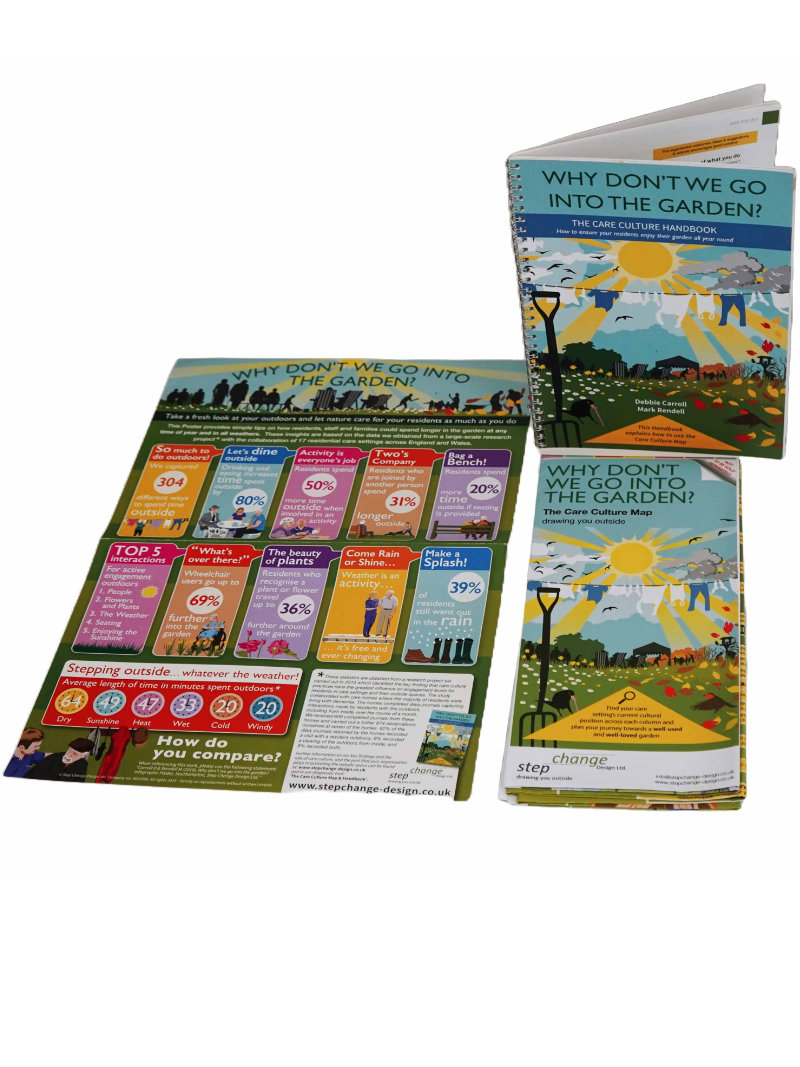
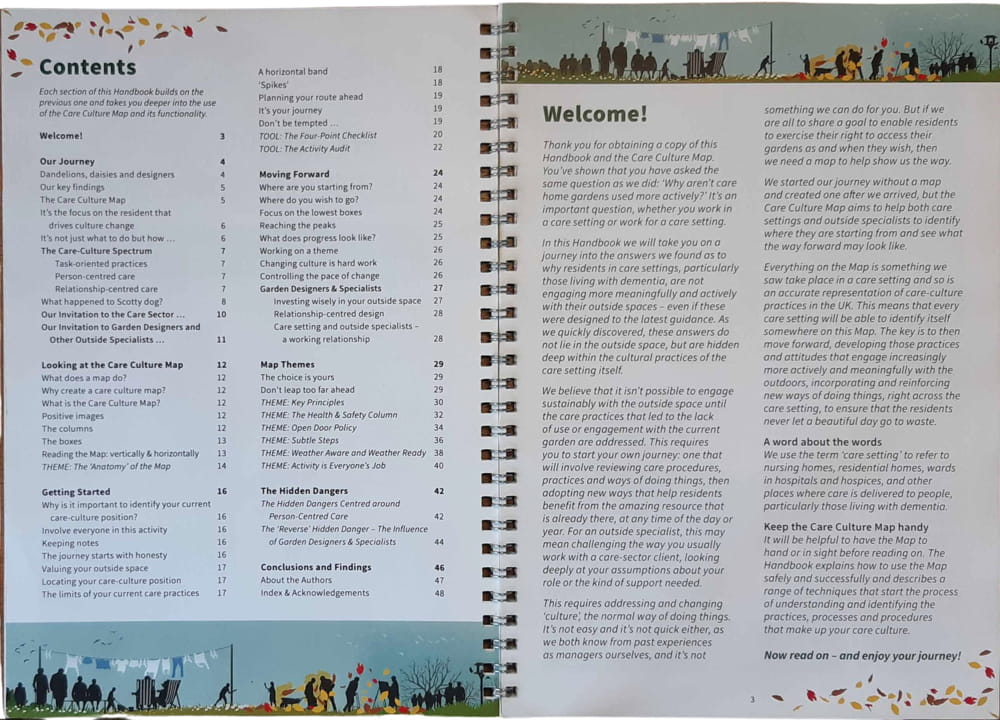
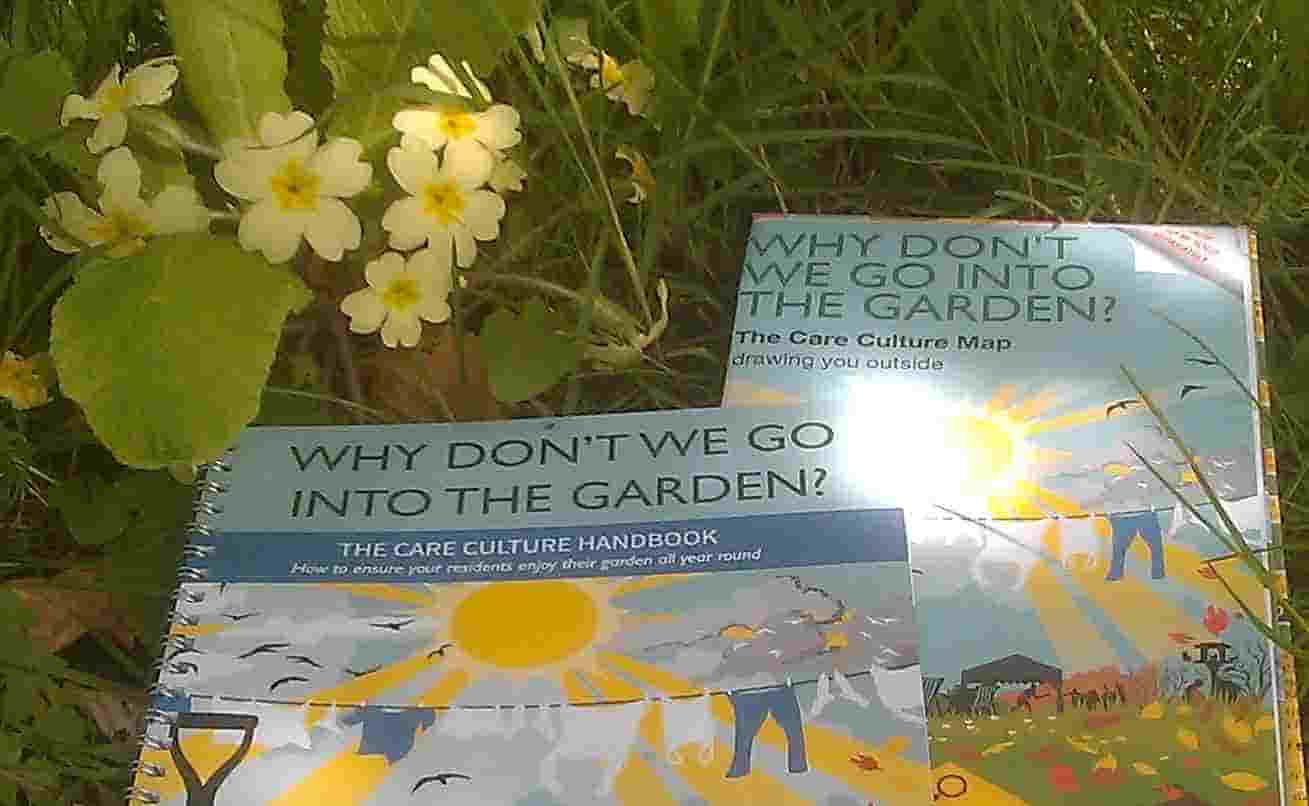
The award winning Care Culture Map and Handbook shares the key findings from our evidence based research into what makes care home gardens more actively used. This package supports care homes, and the outdoor specialists who support them, to identify and address the factors that prevent resident’s regularly and meaningfully engaging with the care home gardens.
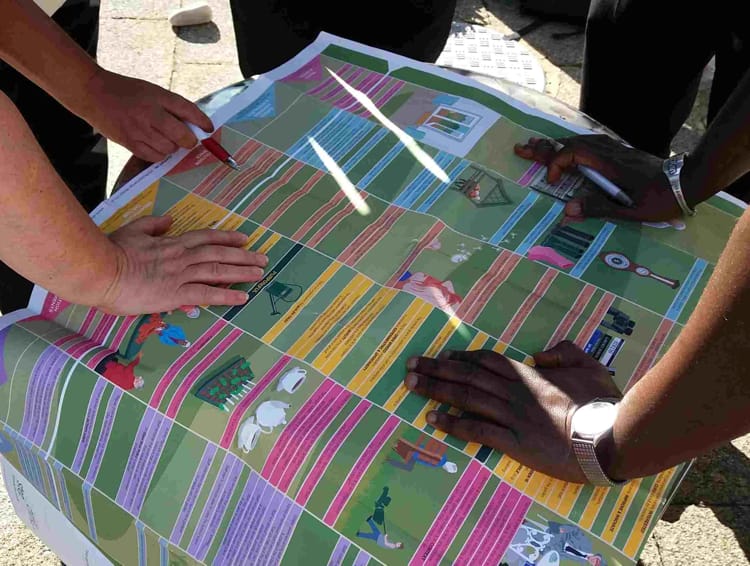
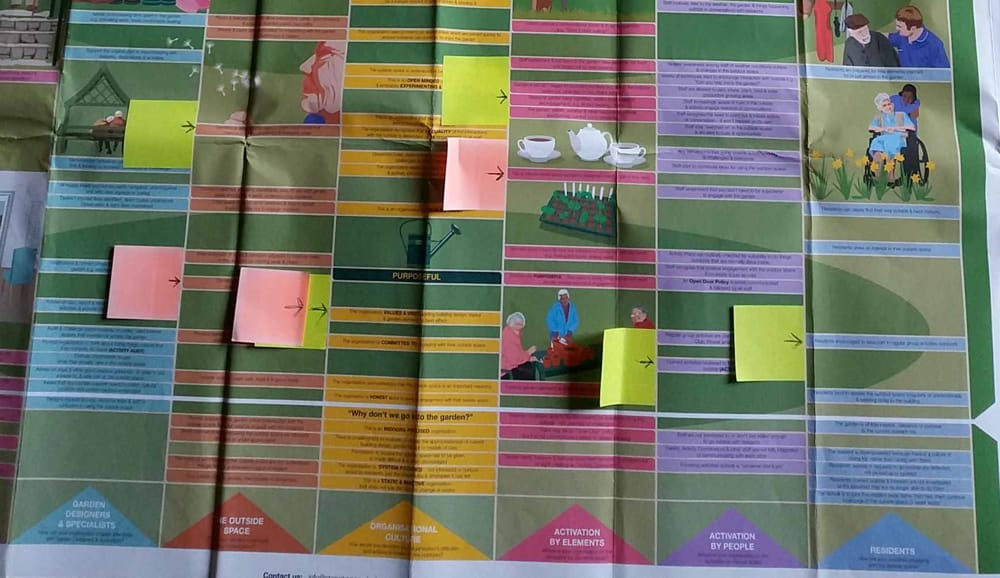
The visually engaging Care Culture Map makes the often complex process of culture change visually accessible and understandable by all staff within care settings allowing progress to be clearly seen, understood and readily communicated. This diagnostic tool enables care settings to locate where they are along a care culture spectrum in relation to Person-Centred and Relationship-Centred Care. It is deliberately paper based to encourage group discussion as to what is holding back greater use of the existing gardens and to agree a route forward.
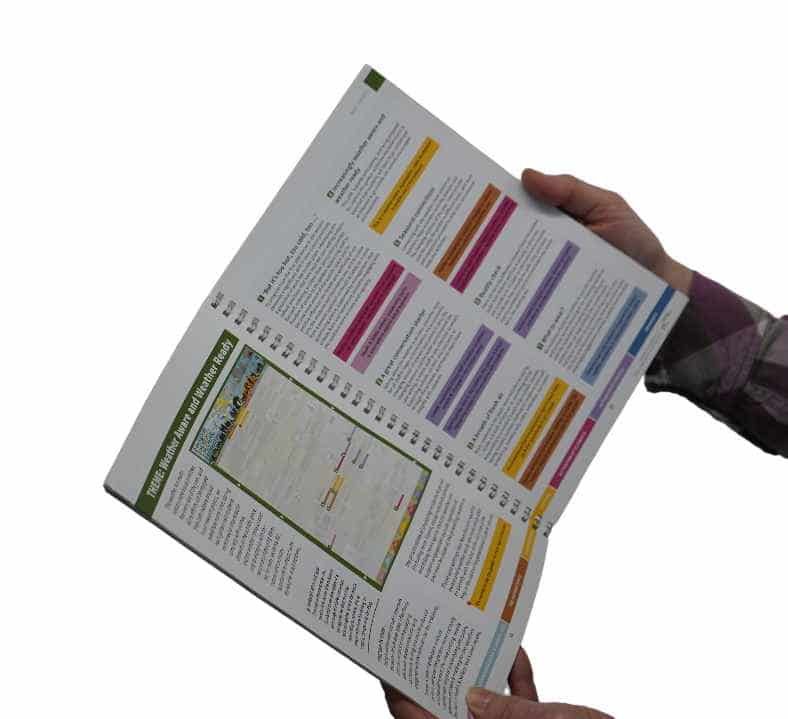
The accompanying handbook explores several common themes to overcome, including: Health and Safety, Open door policies, and being weather ready. Where the support of a garden designer is required to make physical changes this helps care homes and garden designers to work effectively together to ensure the garden is actively used beyond any initial novelty period of a new space. We call this approach ‘Relationship-centred Design’.
Working with the Map tool will often identify practices that are mirrored inside the care home too and so the Map tool can sit comfortably alongside other culture change programmes to achieving more advanced care practices.
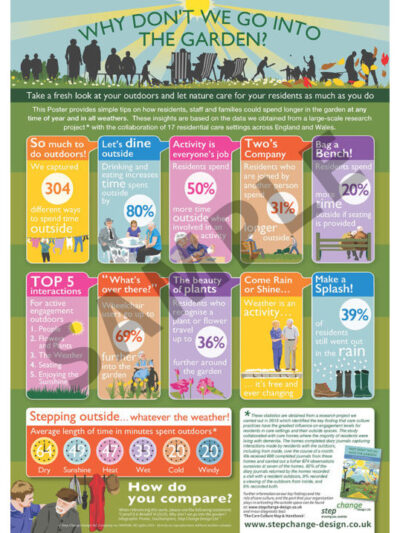
A copy of our A3 Infographic Poster, “Why Don’t We Go Into The Garden?” is included in this package.
Quantity discounts available, please get in touch for more information.
This product is widely available to order through most retailers including via: My care matters and to order through most retailers including Waterstones, despatched via Gardners.
Further information is available for Libraries/ trade wishing to purchase directly, please get in touch
10/06/26 Important notice – We have had an unprecedented level of sales this last month and have placed an order to reprint stocks as they are now low. Our usual speedy delivery will apply to remaining stocks however, our reprinted stock hit a snag with our Map printer experiencing a problem with their specialist printers (this is a big headache for them as they print one of the UK’s most well known Map company Maps!). We should be back to normal stocks and delivery times by the end of this week, 12/6, and you can still place an order if we are showing no stocks and will get your ‘Care Culture Map and Handbook’ out to you as soon as these are back in stock.
In stock (can be backordered)
2 reviews for Why don’t we go into the garden? – Care Culture Map and Handbook
Book Content
Care Culture Handbook content:
This Handbook is divided into five sections. Each section builds on the previous one and takes you deeper into the use of the Care Culture Map and its functionality to create greater engagement with the garden.
Our Journey
Dandelions, daisies and designers
Our key findings
The Care Culture Map The Care Culture Spectrum
It's the focus on the resident that drives culture change
Its not just what you do but how....
The Care-Culture Spectrum
Task-oriented practices
Person-centred care
Relationship-centred care
What happened to Scotty Dog?
Our invitation to the Care Sector...
Our invitation to Garden Designers and Other Outside Specialists...
Looking at the Care Culture map
What does a map do?
Why create a map of care culture?
What is the care culture map?
Positive images
The columns
The boxes
Reading the Map: vertically and horizontally
THEME: The 'Anatomy' of The Map
Getting Started
Why is it important to identify your current care-culture position?
Involve everyone in this activity
Keeping notes
The journey starts with honesty
Valuing your outside space
Locating your current care-culture position
The limits of your current care practices
A horizontal band
'Spikes'
Planning your route ahead
It's your journey
Don't be tempted...
TOOL: The Four-Point Checklist
TOOL: The Activity Audit
Moving Forward
Where are you starting from?
Where do you wish to go?
Focus on the lowest boxes
Reaching the peaks
What does progress look like?
Working on a theme
Changing culture is hard work
Controlling the pace of change
Garden Designers and Specialists
Investing wisely in your outside space
Relationship-centred design
Care setting and outside specialists - a working relationship
Map Themes
The choice is yours
Don't leap too far ahead
THEME: Key Principles
THEME: The Health and Safety Column
THEME: Open Door Policy
THEME: Subtle Steps
THEME: Weather Aware and Weather Ready
THEME: Activity is Everyone's Job
The Hidden Dangers
The Hidden Dangers Centred around Person-Centred Care
The 'Reverse' Hidden Danger - The Influence of Garden Designers and Specialists
Conclusions and Findings
About the authors
Index and Acknowledgements
Testimonials:
“….I'm delighted to have been introduced to you both and your amazing map! It has made me rethink how we use gardens and I'm using it almost daily.”
Head of Nursing, Care & Dementia, Care UK
“I LOVE your books! Arrived last week and I am learning so much- and learning how I, as an eco gerontologist, can apply the knowledge and research your share- so much information. Also, I appreciate the presentation- easy to digest and the Culture Map is awesome! Thank You!!!"
Eco-Gerontologist, USA
Additional information
| Weight | 0.40 kg |
|---|---|
| Dimensions | 29.5 × 18.0 × 2.7 cm |
| Map | A0+ Diagnostic poster, (folded like a Map H300mm x W145mm) |
| Handbook | Spiral bound, H254mm x W178mm, 48pp |
| Poster | A3 sheet folded A4 |
| BIC | Care of the elderly (JKSG), Garden design & planning (WMD), Health systems & services (MBP), Occupational therapy (MQT), Organizational theory & behaviour (KJU) |
| BISAC | BUSINESS & ECONOMICS / Organizational Behaviour (BUS085000), BUSINESS & ECONOMICS / Organizational Development (BUS103000), GARDENING / Garden Design (GAR006000), MEDICAL / Allied Health Services / Occupational Therapy (MED003050), MEDICAL / Nursing Home Care (MED059000) |
| Book Scan class text | Social Issues, Services & Welfare |
| BookScan Class code | S3.3 |
| Dewey | 362.61(DC23) |
| Genre | Non-Fiction |
| Thema | 5PMN (Relating to people with degenerative conditions – including dementia, Alzheimer's disease, etc.), JKSG (Care of the elderly), KJU (Organisational theory & behaviour), MBPN (Residential care – includes elder care, care homes), MQT (Occupational therapy – includes Recreational therapy, Horticultural therapy), WMD (Garden design & planning) |
Bob Scarfo –
Want to bring a garden design to life in a dementia-friendly memory-care facility? Whether a garden designer or care facility administrator, I recommend you read and apply Debbie Carroll and Mark Rendell’s Why Don’t We Go Into the Garden? Care Culture Handbook (2016). The beauty of their practical, easily applied research is their recognition that the culture of a care facility in which a garden design exists or is to be placed is more critical to its success than the quality of the design. The design may be award-winning but if the care facility’s social culture is not supportive of getting into the garden it will likely fail.
As a registered landscape architect, I have devoted my efforts to understanding what environmental designers can bring to the lives of people living with dementia and their care partners. Even so, initially, my training prevented me from seeing the factors bearing on what supports and perpetuates successful actively enjoyed garden experiences. Fortunately, I discovered Carroll and Rendell’s efforts to answer a simple question, “Why Don’t We Go Into the Garden?” It is a poignant two-sided question that their research, research in which they never expected to become immersed, brought them. One side of the question comes from those wishing to go outside and enjoy the benefits of sunshine and the aromas, colors, and textures of various plants. The other aspect of the question becomes more apparent when we ask, “What is Preventing Us from Enjoying the Garden?”
While their research findings are exclusive to the social-management culture of care facilities, much of their findings, the nature and importance of recognizing the care culture, can be transferred to the design and installation of public memory gardens. I wish I was still teaching so I could direct the needed research into what makes for successful public care culture settings.
On behalf of the millions of people living with dementia and the millions of care partners and memory care administrators and staff, I am so grateful for Carroll and Rendell’s practical, down-to-earth research and publications of a little considered approach to successful dementia memory garden designs. Unique to their evidence-based findings is the clarity with which they highlight and simplify the reasons for care-facility gardens failure verses those likely to succeed as vital places of emotional and physical enjoyment. The critical reason is not the quality of the design but the social culture controlling the arena in which a design exists, is set to be refurbished, or into which it will be located. The critical reason is the care culture.
Carroll and Rendell’s firsthand observations and interviews derived from 17 care settings, 600 diary records, and 874 firsthand observations spanning 20 site visits to seven care facilities gave rise to the 3’ x 4’ Care Culture Map.
Visually intimidating at first, the Care Culture Map, in plain, easy to follow language provides 9 progressive care culture settings between Task-oriented Care Practices, Person-centered Care, and Relationship-centered Care. This Care-culture Spectrum enables the designer, in consultation with the culture setting managers to readily identify where their culture setting is situated along the spectrum, what care setting they would like to adopt, and, most importantly, how to get there or what Carroll and Rendell call the Culture-change Journey.
As a poignant, practical, yet critical look at why some memory garden designs succeed and some fail Carroll and Rendell’s garden design program guide vitally strengthens the chances of a highly successful garden design for three reasons. First, in not producing an academic review of their resreach they made their findings readily accessible to and understandable by a broad audience of designers, non-designers, community decision makers, and care facility administrators, managers, and staff. Second, their research may send small tremors through the garden design industry with their eye-opening finding that the quality of a garden design has little to do with the successful use of a garden. The primary influence on a garden’s success or failure resides with the care culture in which it is located.
“While we observed the care practices that were being deployed so deftly and sensitively by the member staff who accompanied the resident [so playfully into a dandelion patch]…we realized that the garden in this care setting for people living with dementia did not need to be pretty or have a variety of features or objects in it in order to be actively used (2016, 4).
[Given that observation] we could see that we needed to re-visit our assumptions that the answer to our original question lay in the design of the garden. We could see that it had something to do with the care culture of the homes, a phenomenon altogether more subtle and harder to capture. Al our subsequent visits to care settings, and our analysis of the information recorded by staff, focused on the practices, processes, and attitudes inside as much as outside the care setting” (2016,4).
And third, in that it provides skilled care facility administrators, especially those caring for people living with dementia and their care partners, with a practical guide, or what Carroll and Rendell call a Care Culture Map, that enables facility administrators and staff to see where they are along a nine-stage care culture spectrum.
Thank you Debbie Carroll and Mark Rendell for pulling the curtain of familiarity back to allow us to see the context, the major factors influencing what is typically considered the success or failure of gardens designed for people living with dementia and their carers and families and friends.
Monica Eastway, M.S., Care Outdoors, Eco Gerontologist –
In Debbie Carroll and Mark Rendell’s research for their handbook, Why Don’t We Go Into the Garden? The Care Culture Handbook,
they discovered:
“The evidence from our research also identified that increasing engagement with the current outside space has little to do with needing more time, more money, or more staff.
Rather, it is all about the value placed by the care setting as a whole on the outdoor space to aid in the care and support of individual residents. Some of the most actively used gardens in our research were those that had the least money spent on them and the fewest features.”
As an Eco Gerontologist passionate about optimizing the therapeutic use of outdoor spaces, I highly recommend the Care Culture Handbook and Map. These tools are easy to understand and are perfect for engaging your care team to value outdoor engagement as a form of care. The Care Culture Map is a fantastic diagnostic tool to assess where your community stands and to discover simple ways to elevate your care to the highest level: ‘Relationship-Centered Care’.
Fully Valuing ‘daily’ outdoor engagement as a form of care is key to maximizing the therapeutic benefits of outdoor spaces. Thank You so much Debbie and Mark!!!